

 Our Mission & Values
 Governance & Partnerships
 Global Reach
 Our impact
 Agricultural Solutions
 Our Environmental Responsibility
 All Our Magazines
 Articles Library
 Our Subscriptions


The first steps towards a circular approach to agricultural plastics in Chile
Authors: Lucile Richard & Nesko Kuzmicic, Operations and Circular Economy Unit, ProREP
Since 2016, Chile has had an Extended Producer Responsibility (EPR) Act, which sets collection and recovery targets for priority products. ProREP was established to manage the recovery of industrial and commercial packaging. Building on this, the AgroCircular project has been designed specifically for the agricultural sector. Let’s take a look at what’s being put in place.
EPR regulation in Chile: ambitious goals for a vast country
The Chilean economy relies heavily on the export of natural resources, with mining, forestry, agriculture and fisheries as key sectors. A member of the OECD since 2010, the country faces the complex challenge of balancing productivity with environmental sustainability.
In 2016, the Extended Producer Responsibility (EPR) Act was enacted, setting collection and recovery targets for seven priority products – including packaging, tyres, lubricating oils and, more recently, textiles. To make up for the delay in implementing this legislation, the country has set itself extremely demanding targets, particularly for packaging, which implementation began in 2022 and aims to achieve recycling levels comparable to the European average by 2030.
This pace presents major adaptation challenges. To name a few: recycling capacity is concentrated in the Metropolitan Region and the central part of the country, whilst many of the relevant productive activities operate in remote areas, hundreds or thousands of kilometres from that infrastructure. Ensuring that their waste enters the recovery cycle is a logistical, technical and economic challenge of the first order.
ProREP’s dual strategy
At the heart of this initiative lie the management systems known as “Producer Responsibility Organisations” (PROs). ProREP was established in 2022, alongside the targets for packaging, driven in particular by RIGK – a European leader in industrial packaging management – and Valipac, which has experience with the Belgian model. ProREP now brings together more than 650 member companies and has a specific mandate: to meet the recovery targets for non-household packaging, which it has annually achieved since 2022. However, to ensure the long-term success of these targets, ProREP has also developed early assessments of complex waste streams and implemented pilot projects that now enrich its strategy, including initiatives for plastics in the agricultural sector.
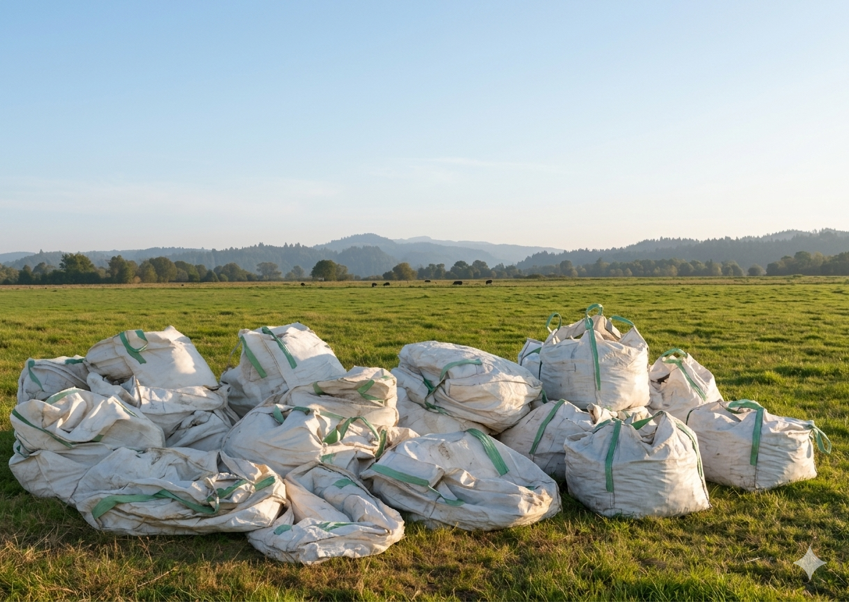
ProREP has thus adopted a two-pronged approach: to efficiently meet global regulatory targets and, in parallel, to develop initiatives to address more complex cases with a high environmental impact and a low rate of proper management. This approach now extends to several sectors: packaging generated by the mining industry, plastic waste from the construction sector, and lubricant oil packaging, amongst other circular economy projects currently under development. One of the most emblematic cases has been that of polypropylene ‘big bags’ in the agricultural sector, which for years lacked dedicated recycling facilities and led to informal disposal practices – burial, burning, abandonment – with pernicious environmental impacts.
Example of waste collection
There are many variations of passages of Lorem Ipsum available, but the majority have suffered alteration in some form, by injected humour, or randomised words which don't look even slightly believable. If you are going to use a passage of Lorem Ipsum, you need to be sure there isn't anything embarrassing hidden in the middle of text. All the Lorem Ipsum generators on the Internet tend to repeat predefined chunks as necessary, making this the first true generator on the Internet. It uses a dictionary of over 200 Latin words, combined with a handful of model sentence structures, to generate Lorem Ipsum which looks reasonable. The generated Lorem Ipsum is therefore always free from repetition, injected humour, or non-characteristic words etc.
From this magazine