

 Our Mission & Values
 Governance & Partnerships
 Global Reach
 Our impact
 Agricultural Solutions
 Our Environmental Responsibility
 All Our Magazines
 Articles Library
 Our Subscriptions


Greenhouses in Mediterranean Horticulture: Yield, Resource Efficiency and Competitiveness
Author : Bernard Le Moine¹, APE Europe
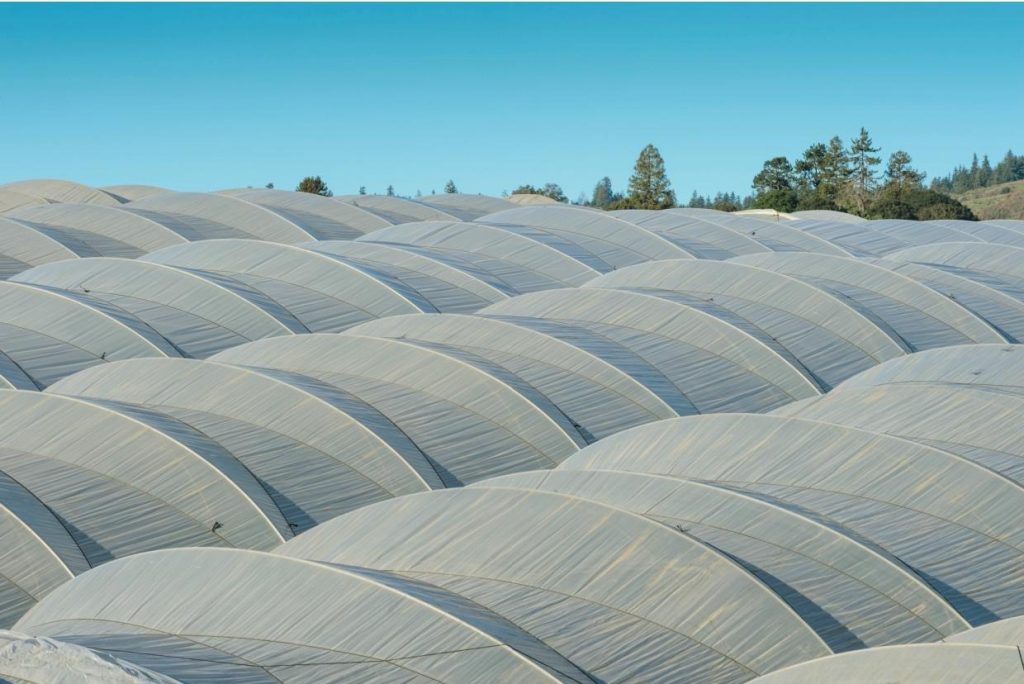
Greenhouses are a fundamental ally of crop production. Plasticulture Magazine publishes a new and comprehensive study of plastics greenhouses in horticulture in the Mediterranean basin.
Protected cultivation has become a central component of horticultural development in the Mediterranean Basin, where plastic, mainly polyolefin film-based greenhouses constitute around 90% of the greenhouse infrastructure [1]. Between the early 2000s and the early 2020s, greenhouse areas in the region expanded from approximately 168,000 ha [2] to about 260,000 ha [1], with the growth largely driven by Mediterranean countries such as Spain, Italy, Turkey, Morocco and France [1,3].
Greenhouse Technology Levels
Greenhouse systems in the Mediterranean Basin can be grouped into three technological levels.
Low-technology greenhouses are simple, non-heated plastic tunnels relying on passive climate control and offering limited yield stability.
Medium-technology greenhouses are walk-in or improved plastic multi-span structures with enhanced ventilation and fertigation, provide a balanced compromise between investment cost and productivity and dominate regional horticulture.
High-technology greenhouses are capital-intensive systems, double-panelled plastic or glass-covered, equipped with active climate control, CO₂ enrichment and automation, delivering the highest yields but remaining limited to highly capitalised projects.
Investment Levels and Structural Advantages of Plastic Greenhouses
The large share of plastic greenhouses in Mediterranean protected agriculture can be attributed to their low investment costs, light weight, structural flexibility and ease of installation along with high transmission of photosynthetically active radiation. In the Mediterranean Basin, polyethylene (PE) films, mostly low-density polyethylene (LDPE) are predominantly used in low- and medium-tech greenhouses. Low-tech greenhouses typically require investment under €30 per m2, while the estimated investment for medium-tech plastic greenhouses ranges from €30–60 per m² [4]. Typically, glass greenhouses belong to high-tech systems with investment levels from €100 to over €170 per m² [5], with some of the most expensive structures costing up to €500 per m² [4] which limits their adoption in most Mediterranean contexts.
PE Films as the Enabling Material of Plastic Greenhouses
Modern PE greenhouse films are typically multilayer structures incorporating additives that improve durability, light diffusion and microclimate control. Film lifetimes generally range from 6 to 45 months, depending on formulation and climatic conditions. The greenhouse films are typically made of LDPE due to their suitable mechanical and optical properties (light weight and flexible, transparent to thermal radiation with 70–95% solar transmittance) along with a competitive market price.
Yield Performance as the Primary Driver of Protected Cultivation
Yield performance constitutes the primary agronomic and economic rationale for the expansion of plastic greenhouse. Across crops and regions, protected cultivation consistently outperforms open-field systems. This article analyses the yield performance of plastic-based protected vegetable production systems under Mediterranean conditions, with a focus on tomatoes as a reference crop considering they constitute the primary crop in greenhouses, covering 36% of global greenhouse area [4].
For tomatoes, depending on cultivation practices, average yields under plastic greenhouses range from 120 to 180 t ha⁻¹ in low- and medium-tech systems (Fig. 1). The typical yields for low- to medium tech systems reported can range from 90 to 170 t ha⁻¹ (interquartile ranges in Fig. 1) but can exceed 200 t ha⁻¹ under optimal conditions. One study reported truss tomatoes yields of over 400 t ha-1 for mid-tech greenhouses in Egypt [6], but higher values sometimes reported in the literature often correspond to more advanced multi-tunnel or semi-controlled systems. High-tech greenhouses with optimised structures and highly controlled environments typically report tomatoes yield of 300 to over 450 t ha⁻¹ (Fig. 1) but are not that common in the Mediterranean Basin due to associated high costs.
By contrast, average tomato yield under open-field tomato production is around 60 t ha⁻¹ with the typical yield range of 40–80 t ha⁻¹ (Fig. 1), and with a high interannual variability. Depending on the technology used, the average yield range gains for tomatoes under plastic greenhouses can reach a factor of 2 to 6 over open-field production, establishing protected cultivation as a cornerstone of productivity intensification in Mediterranean horticulture. Tomato yield data reported in this article is based on literature and internet review conducted for this study.
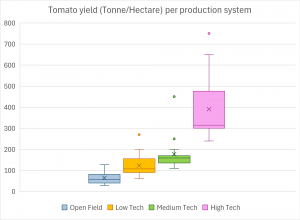
Observed minimum, maximum, and average tomato yields (open field cultivation and greenhouses in the Mediterranean Basin ); with interquartile range (boxes), median (horizontal line), minimum and maximum observed value (whiskers), average values (“X”), and data outliers (dots).
Agronomic Mechanisms Underpinning Yield Intensification
These yield advantages result from a combination of agronomic drivers inherent to plastic-protected systems. Microclimate regulation enables growers to manage temperature, humidity and ventilation, thereby reducing abiotic stress. Advances in greenhouse films, including light-diffusing and UV-selective materials, improve photosynthetic efficiency and crop uniformity.
Precision fertigation and, increasingly, soilless cultivation allow optimised nutrient delivery while reducing losses. Higher planting densities extended cropping cycles and integrated pest management further contribute to yield intensification. Collectively, these factors lead to productivity gains in comparison with open-field systems under comparable pedoclimatic conditions.
Resource-Use Efficiency and Input Management
Beyond yield levels, plastic greenhouses can significantly enhance resource-use efficiency. Water-use efficiency can be significantly higher in protected cultivation [7,8]. For example, a study conducted by University of Cordoba in Spain demonstrated that growing tomatoes in a greenhouse reduced product water use about five-fold compared to growing in the open field [7].
Several studies indicate that greenhouse cultivation generally improves fertiliser-use efficiency compared with open-field systems, mainly through precision fertigation and controlled nutrient delivery [9]. Nutrient losses through leaching and volatilisation can be significantly reduced in controlled fertigation systems. Fertigation systems in closed soilless cultivation systems can further improve resource efficiency by recirculating nutrient solutions, reducing nutrient inputs by 40-50% for greenhouses, while maintaining high yields [10]. However, total fertiliser inputs per hectare may remain relatively high due to greater crop density and higher yields in protected cultivation systems.
Regarding chemical crop protection, open-field systems exhibit high variability linked to climatic exposure and pest pressure. Greenhouse systems reduce external contamination but may favour the proliferation of specific pests, potentially increasing treatment needs if poorly managed. However, protected cultivation facilitates the implementation of integrated pest management (IPM) strategies, enabling more targeted and potentially reduced use of chemical products. Overall, resource and chemical use intensity related to fertilisation and crop protection remain significant in intensive systems and depend strongly on management practices rather than on the production system alone. Table 1 provides a comparison summary of resource efficiency and input management for open field and greenhouse cultivation.
Table 1. Indicative comparison of resource-use and management practices in open-field and greenhouse tomato production systems.
Final Thoughts
Tomato yields from greenhouse systems can vary significantly across the Mediterranean Basin depending on geographic conditions, water availability, management practices and farm structures. A clearer acknowledgment of this variability helps to better contextualise results and avoid overgeneralisation.
At farm level, greenhouse tomato production generates substantially higher net returns than open-field cultivation in the Mediterranean Basin, despite significantly higher production costs [11]. This advantage is driven by higher yields, improved product price levels, and greater production stability, with profitability increasing further as greenhouse technology intensifies. Moreover, protected cultivation provides markedly greater stability, shielding crops from extreme temperatures, irregular rainfall and other weather-related hazards. This stability is critical for farm income security and long-term resilience.
At the macroeconomic scale, plastic greenhouse systems underpin export-oriented strategies and contribute to rural employment and trade balances. Countries such as Spain, Morocco and Turkey have built competitive advantages on non-heated plastic greenhouses supplying European markets during winter months. For example, Morocco is the third largest exporter of tomatoes in the world after Mexico and Netherlands, generating €1.066 billion from exports in 2024, compared to €113 million in 2005, reflecting approximately a tenfold increase [12] in export value.
In the context of population growth and rising food demand, this study shows that plastic greenhouse systems have become a structural pillar of Mediterranean horticulture, offering the ability to combine high yields, efficient resource use and economic competitiveness at relatively moderate investment levels. Continued progress in energy efficiency, greenhouse design and input optimisation will be critical to consolidating the role of plastic-protected cultivation as a resilient and scalable response to food security challenges in the Mediterranean Basin.
Acknowledgement: This study received funding from ExxonMobil. Such funding does not constitute or imply endorsement of any part of this work.
References
- Nikolaou, G., et al. (2021). Horticulturae, 7(12), 521.
- Jouet, J.P. 2001. Plastics in the world. Plasticulture 2(120):106-127. (Cited in Pardossi, A., et al. (2004). Mediterranean greenhouse technology. Chronica horticulturae, 44(2), 28-34)
- Zimmerer, K. S., & Bell, M. G. (2025). Geography Compass, 19(4), e70027.
- RaboResearch (February 2025). Global Greenhouse Update 2025.
- Cfget Greenhouse (2025). Cost to build a greenhouse 2025 guide – Real pricing, hidden costs, & budget levels explained?
- Delphy (December 2023). Market Study on Protected Cultivation in Egypt: Road toward a consortium on Climate and Water Smart Protected Cultivation.
- Nederhoff, E., & Stanghellini, C. (2010). Water use efficiency of tomatoes. Practical Hydroponics and Greenhouses, (115), 52-59.
- Martínez-Blanco, J., et al. (2011). Journal of cleaner production, 19(9-10), 985-997.
- Yan, B., Deng, T., & Shi, L. (2024). Plants, 13(20), 2885.
- Savvas, D., et al. (2023). Agronomy, 14(1), 61.
- Yelmen, B., et al. (2019). Applied Ecology & Environmental Research, 17(4).
- Morocco World News (November11, 2025). Morocco Becomes World’s Third-Largest Tomato Exporter, Overtaking Spain.
¹ https://apeeurope.eu/; Contact: b.lemoine@apeeurope.eu.
² Morocco, Algeria, Tunisia, Egypt, Israel, Turkey, Greece, Italy, France, Spain.
³ Tomato yields data in the chart and article main text is based on literature review conducted for this study.
From this magazine