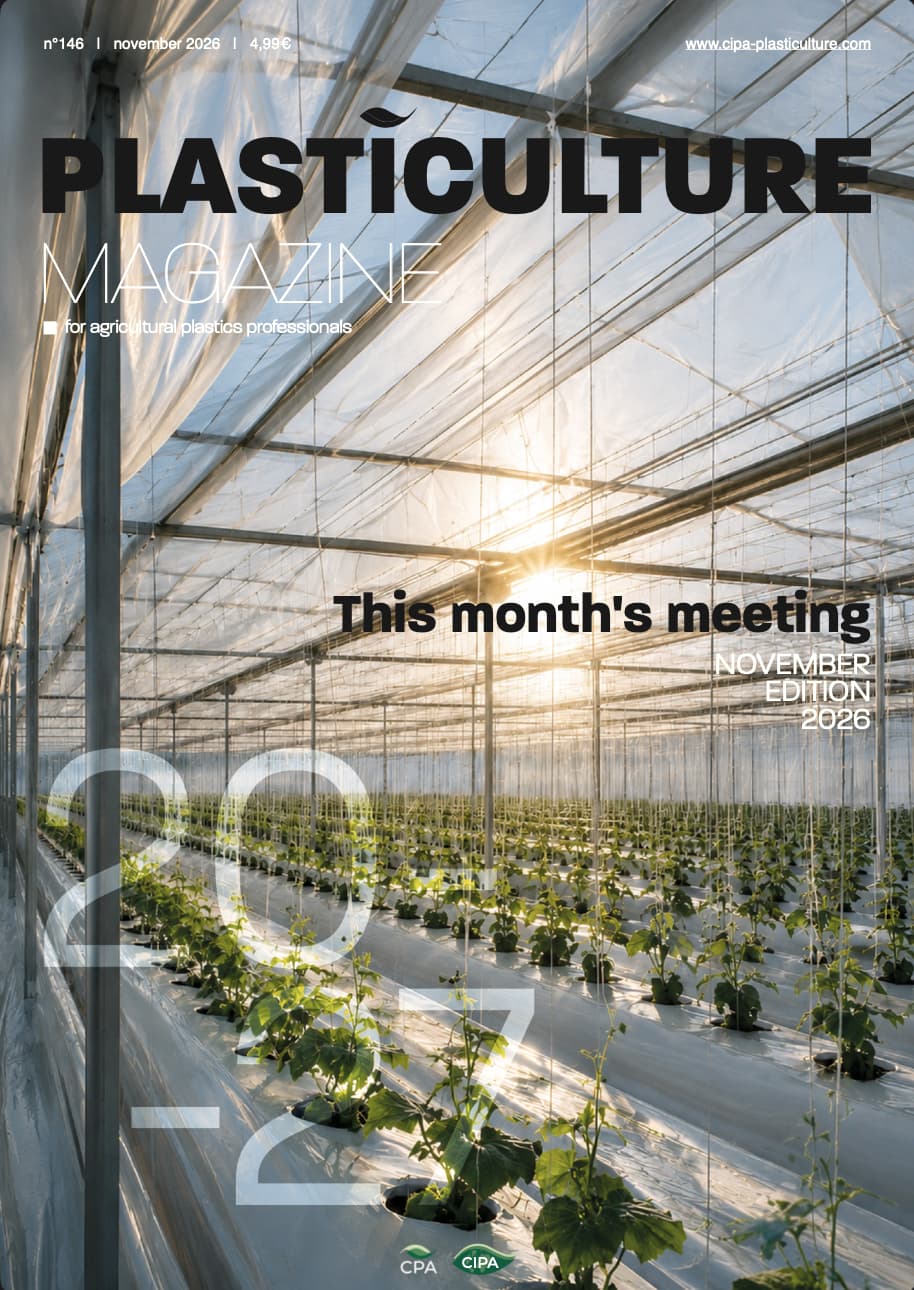
Plasticulture Magazine – N° 146 – November 2026
This November edition of Plasticulture Magazine explores the balance between agricultural performance, environmental sustainability, and circularity throughout the plastics value chain. The issue highlights research from Brazil’s University of Campinas (UNICAMP), advocating a holistic approach to agricultural plastics that considers productivity, material durability, recovery systems, and life-cycle impacts. It also examines UBSIDE’s scientific work in France on sustainable polymers, biodegradation, ecotoxicity, and recycling, emphasising the importance of eco-design and life-cycle assessment. An interview with Professor Bernd Nowack from Switzerland’s Empa introduces probabilistic modelling to quantify macroplastic and microplastic emissions into soils, highlighting the need for more reliable environmental data. The edition also addresses the revision of European standard EN 15343, demonstrating how harmonised traceability, transparent recycled-content verification, and digital documentation can strengthen confidence in secondary raw materials. Overall, this issue emphasises scientific evidence, responsible material design, and standardised traceability as essential foundations for a more sustainable and efficient circular economy for agricultural plastics.
Plasticulture Magazine – N° 146 – October 2026
This October edition of Plasticulture Magazine explores the latest innovations, scientific developments, and regulatory initiatives shaping the future of agricultural plastics recycling. The issue highlights Sweden’s pioneering investment in a dedicated recycling facility for non-woven crop covers, demonstrating how industrial innovation and cooperation across the value chain can transform challenging waste streams into valuable resources. It also examines IPC’s advances in supercritical CO₂ decontamination, a promising technology for improving recycled polymer quality and expanding circular applications. The edition addresses emerging scientific findings on microplastics in agricultural soils through the European MINAGRIS project, emphasising the need for harmonised monitoring methods and stronger collaboration between researchers and industry. Further insights cover New Zealand’s transition toward a regulated Extended Producer Responsibility scheme for agricultural plastics and European efforts to simplify cross-border recycling through the inclusion of agricultural plastics on the EU’s Green List. Overall, this issue highlights technological progress, international cooperation, and regulatory solutions driving a more efficient and sustainable circular economy for agricultural plastics.
Plasticulture Magazine – N° 146 – September 2026
This September edition marks the return of Plasticulture Magazine’s monthly digital format and highlights the international momentum behind circular agricultural plastics. The issue explores Brazil’s “Eu Plastifico, NÓS RECICLAMOS!” initiative, a voluntary model connecting farmers, recyclers, manufacturers, and institutions to build traceable recycling pathways and generate recycled resin. It also features RVPO’s renewed strategy in France to strengthen LDPE agricultural film recycling, the KISS project in Germany showing how AI and material data can improve recyclate quality, and Belgium’s move toward a harmonised national collection and recycling scheme. The edition closes with a European regulatory perspective on Extended Producer Responsibility, eco-modulation, and the need for a stronger market for secondary raw materials. Overall, this issue focuses on practical systems, digital innovation, and policy tools that can turn agricultural plastics into valuable resources within a circular economy.


 Our Mission & Values
 Governance & Partnerships
 Global Reach
 Our impact
 Agricultural Solutions
 Our Environmental Responsibility
 All Our Magazines
 Articles Library
 Our Subscriptions