

 Our Mission & Values
 Governance & Partnerships
 Global Reach
 Our impact
 Agricultural Solutions
 Our Environmental Responsibility
 All Our Magazines
 Articles Library
 Our Subscriptions


From field to policy: European stakeholders align on the future of agricultural plastics recycling
Author : Kathleen Laissy, Managing Director, APE Europe
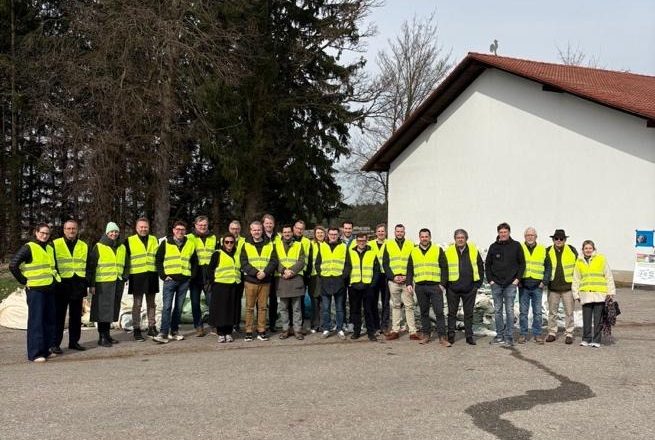
On 19 and 20 March 2026, key stakeholders from across Europe’s agricultural plastics value chain gathered in Irsee near Munich for the European National Collection and Recycling Schemes (NCRS) Meeting. Over two days, participants – from industry leaders and national schemes to policymakers and recyclers – shared one clear message: the future of agricultural plastics will depend on the successful deployment of NCRS.
From the field: Germaringen collection point
The meeting began where circularity truly starts: on the ground, with a visit of a collection point in Willebadessen, Bavaria, a concrete example of how NCRS operate in practice.
Twice a year, farmers from the surrounding region bring their used agricultural plastics to this site. What we saw was both simple and powerful: used silage films, stretch films, nets and twine, carefully gathered and sorted, often packed in dedicated collection bags such as those provided under the ERDE system, awaiting collection and recycling.
Often heavily soiled with dirt and organic residues, these plastics reflect the real conditions of agricultural use, and their usage also varies significantly depending on the season. Their collection and recycling therefore require dedicated systems, adapted logistics and engaged users. Local actors, including contractors and cooperatives, play a crucial role in organising logistics. The system works because it is embedded in local agricultural practices.
Visit to a collection point in Willebadessen (Germany)
A shared conclusion: NCRS are the cornerstone of circularity
Discussions confirmed what the field visit had already illustrated: NCRS are the only proven model capable of delivering circularity for agricultural plastics at scale. Across Europe, systems at different stages of maturity – Germany, France, Ireland, Switzerland, as well as emerging initiatives in the Netherlands, Belgium and the UK – demonstrate that:
- High collection and recycling rates are achievable,
- Systems can be adapted to national contexts,
- Industry-led approaches can deliver concrete results.
However, they also highlighted a critical reality: success depends on system design, governance and full participation. This final point is key and is common to all systems: free-riders are the biggest threat to NCRS performance. Whether in voluntary or regulated systems, actors who place products on the market without contributing to collection and recycling undermine financial sustainability, fair competition and trust in the system. The conclusion is clear: no circular system can function without full market participation.
There are many variations of passages of Lorem Ipsum available, but the majority have suffered alteration in some form, by injected humour, or randomised words which don't look even slightly believable. If you are going to use a passage of Lorem Ipsum, you need to be sure there isn't anything embarrassing hidden in the middle of text. All the Lorem Ipsum generators on the Internet tend to repeat predefined chunks as necessary, making this the first true generator on the Internet. It uses a dictionary of over 200 Latin words, combined with a handful of model sentence structures, to generate Lorem Ipsum which looks reasonable. The generated Lorem Ipsum is therefore always free from repetition, injected humour, or non-characteristic words etc.
From this magazine