

 Our Mission & Values
 Governance & Partnerships
 Global Reach
 Our impact
 Agricultural Solutions
 Our Environmental Responsibility
 All Our Magazines
 Articles Library
 Our Subscriptions


The effect of protective nets on the microclimate of orchards
AUTHORS : Amandine BOUBENNEC, Research Engineer, French Interprofessional Technical Centre for Fruits and Vegetables (CTIFL) & Anna GAUTIER, Research Engineer, CTIFL
Insect nets can have an impact on the microclimate of the plot. The Ceris’innov looks at various climate indicators in order to better understand how to combine pest protection with resilience to climate change.
In addition to facilitating maintenance and harvesting operations, which can sometimes be difficult to carry out with a single-row net, the whole-plot net targets Drosophila suzukii (or ‘Asian fruit fly’), which is a formidable pest for small fruits (cherries, strawberries, raspberries, blueberries, plums, etc.). However, its use alters the microclimate of the plot. This is what the Ceris’innov project, led by CTIFL, is analysing in order to study the technical and economic feasibility of cherry production under whole-plot insect nets.
Technical specifications of the experiments
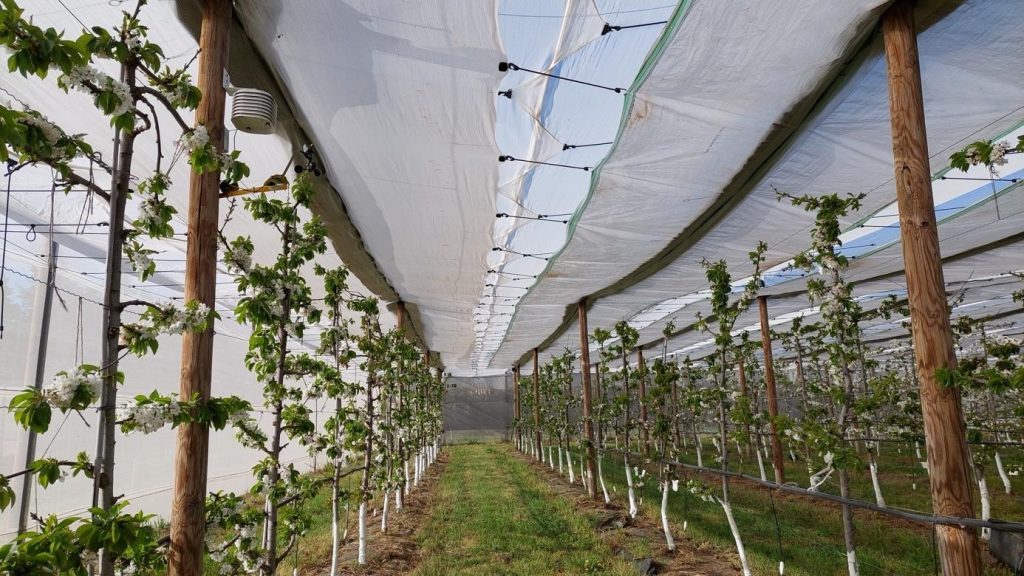
The test plot consists of eight rows of 25 trees, including three rows of the early variety Nimbacov, two rows of the seasonal variety Babellecov and three rows of the late variety Staccato®. The rows are spaced 3.40 m apart and the trees 2 m apart, with the trees trained in a straight line and the plot laid out as a flat hedge with partial mechanisation of pruning. Pollination is provided by bumblebees, whose hive is installed inside the plot at the beginning of flowering.
The total area covered is 1,360 m2, with each row of the orchard covered by two lengths of stretched netting, which edges are buried one metre deep to ensure maximum waterproofing. The netting provides a theoretical shade of 18%. The plot is also protected by a 40 g/m2 plasticised rain cover, placed between the cherry trees and the insect net, which has a mechanical resistance of 120 N per 5 cm.
22 weather sensors – measuring temperature and humidity under cover, wind speed and direction, as well as radiation– are distributed across nine measurement points in the net-covered plot. The data presented in this article comes from the three sensors located in the centre of the orchard, the area considered to be the most representative of intra-plot conditions. These measurements are compared with those from a control plot of the same type located in the immediate vicinity of the covered plot. The analysis presents the main results of the 2023 and 2024 data.
Plot of cherry trees under insect nets and rain covers
There are many variations of passages of Lorem Ipsum available, but the majority have suffered alteration in some form, by injected humour, or randomised words which don't look even slightly believable. If you are going to use a passage of Lorem Ipsum, you need to be sure there isn't anything embarrassing hidden in the middle of text. All the Lorem Ipsum generators on the Internet tend to repeat predefined chunks as necessary, making this the first true generator on the Internet. It uses a dictionary of over 200 Latin words, combined with a handful of model sentence structures, to generate Lorem Ipsum which looks reasonable. The generated Lorem Ipsum is therefore always free from repetition, injected humour, or non-characteristic words etc.
From this magazine